“PLEASANT INNS” ALONG THE WAY

We’ve just wrapped up another school year at Wheaton College, and I couldn’t be more delighted.  Don’t get me wrong.  It is a privilege to teach here, and I love working with, and learning from, the talented and highly motivated students who fill my classes.  Yet the summer affords the luxury of sustained reading, and the even greater gift of sustained reflection, and I couldn’t be more excited.  I spend hours of most summer days on a bench near a tiny lake near our home, and every morning that I take my customary seat and feel the sun on my face and hear the breeze rustling through the leaves and see the sun sparkling on the water and, on top of it all, I get to open a good book, I praise God for his kindness.

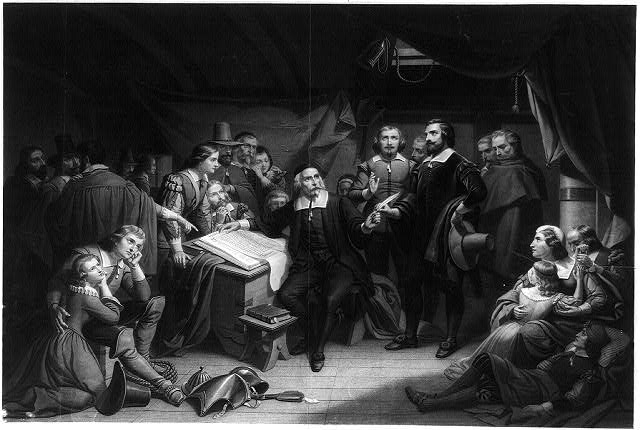
Like the Pilgrims that I have been studying, I think that we should never feel wholly comfortable in this life.  The world is not our home.  The New Testament letter to the Hebrews calls us “pilgrims” and “sojourners”–travelers to a better country.  I believe that with all my heart, but I also believe that God in His kindness still gives us countless pleasures in this life.  C. S. Lewis captured this idea perfectly with one of his memorable metaphors.  Let me quote from his book The Problem of Pain:

“The settled happiness and security which we all desire, God withholds from us by the very nature of the world: but joy, pleasure, and merriment He has scattered broadcast.  We are never safe, but we have plenty of fun, and some ecstasy.  It is not hard to see why.  The security we crave would teach us to rest our hearts in this world and oppose an obstacle to our return to God: a few moments of happy love, a landscape, a symphony, a merry meeting with friends, a bathe or a football match, have no such tendency.  Our Father refreshes us on the journey with some pleasant inns, but will not encourage us to mistake them for home.”

Here Lewis likened moments of delight to “pleasant inns” that our Father has placed at intervals along our journey.  We must not mistake them for home–we are pilgrims, en route to a better country–but we can, and should, enjoy such blessings gratefully.  For me, one of the pleasant inns that refreshes my soul is that lakeside bench on a sunny summer day.

Lake Ellyn Park, Glen Ellyn, Illinois

Lake Ellyn Park, Glen Ellyn, Illinois

Most of what I read on that bench has to do in some way with faith and history, and that also makes me happy.  I recently came across a letter that I wrote nine years ago to the elders of my church when we were living in Seattle.  “God has been opening my eyes to a new sense of calling,” I told them.  “I want to spend the rest of my life reading, learning, writing, and teaching on topics at the intersection of Christian faith, the study of history, and the life of the mind.”

When I sit on that bench with a history book in my lap, I genuinely believe I am pursuing the Lord’s calling.  As corny as it sounds, I regularly think of that great line from the movie Chariots of Fire, when Eric Liddell tells his sister, “God made me fast, and when I run I feel his pleasure.”  It’s not that I have it all figured out, to paraphrase the apostle Paul in Philippians, chapter 3.  I am still trying to understand what it means to think Christianly about the past.  That’s why I am so grateful for this opportunity to think out loud with you and benefit from your input and feedback.

My first bench reading of the summer was A Free People’s Suicide, by Os Guinness.  In my recent posts I have been focusing on examples of how NOT to think historically, concentrating on works by Peter Marshall Jr. and David Manuel, Francis Schaeffer, and Steve Wilkins and Doug Wilson.  In contrast to these, I think that Guinness offers Christians a model worthy of imitation.  I don’t agree with his interpretation in every respect, but we don’t have to agree completely with a historical argument to learn from it.  In my opinion, the way that Guinness has appealed to the past in the structure of his argument is fundamentally sound.  In my next post, I will explain why I think so.

Back soon!

HOW NOT TO ARGUE HISTORICALLY: THOUGHTS ON “SOUTHERN SLAVERY AS IT WAS”

In my last two posts I have been talking about the dangers of grounding essentially religious arguments about the present in historical assertions about the past.  Drawing examples from the writings first of Peter Marshall Jr. and David Manuel and then of Francis Schaeffer, I have argued that such as approach has awful consequences.  The worst is that these writers effectively backed themselves into a corner in which it was impossible to admit historical errors.  Any mistakes in their interpretation of the American past would seem to undermine their religious critique of the American present.  In Schaeffer’s case, at least, this led him to group critics of his interpretation of U. S. history with “weak Christians” who don’t fully believe the Scriptures.

It is easy for us to condemn this as unbridled arrogance, but let me check that impulse with this reminder: In books like The Light and the Glory and How Should We Then Live?, Marshall, Manuel, and Schaeffer were courageously calling American evangelicals to think deeply about the surrounding culture, to “take very thought captive in obedience to Christ.”

Schaeffer, in particular, was contesting a deeply entrenched fundamentalist tendency to be suspicious of intellectual pursuits.  He challenged American Christians, instead, to think Christianly about science and philosophy, art and architecture, music and medicine and politics.  His writings about history were  a seamless part of this larger project, and even Christian historians who are skeptical of his historical interpretations–and almost all of them are–give Schaeffer credit for motivating a generation of believers to take the life of the mind more seriously.  That is a huge accomplishment.

And yet good intentions without discernment can still do much harm.  My point in these posts has not been to provide a “final answer” about the degree to which the American founding was Christian (as if that were possible!), as important as that question is.  No, my goal has been to call attention to the damage we can do in conflating the authority of Scripture with the force of our own fallible interpretations of the American past.

Toward that end, I want to share one final illustration of how not to argue historically.  The work I have in mind is a booklet from the 1990s titled Southern Slavery as It Was, authored by two prominent Reformed pastors, Douglas Wilson and Steven Wilkins.

Of the two, Wilkins, a Presbyterian pastor from Louisiana, is probably less well known today, but Wilson is growing in name recognition.  For decades he has been a prominent figure in the Northwest, having founded a church, grammar school, college, and press in his home base of Moscow, Idaho.  Of late he has increased in national stature, thanks especially to his well publicized debates with the (now deceased) atheist Christopher Hitchens, to his growing prominence within the Gospel Coalition, and by his recent authorship of the satirical novel Evangellyfish, which Christianity Today named the best work of fiction in 2012.

SSAIW

Southern Slavery as It Was is a textbook example of the danger of grounding religious arguments in historical interpretations.  Unlike Marshall and Manuel and Schaeffer, who linked their critique of the contemporary U. S. to debatable assertions about the American founding, Wilson and Wilkins went into battle wielding a contentious interpretation of slavery and the Old South.

“The South has long carried the stigma of racism and bigotry,” the authors declare in the booklet’s first sentence.  “The institution of slavery has so blackened the Southern position that nothing about the South can be viewed as good or right. . . . We have all heard of the heartlessness–the brutalities, immoralities, and cruelties–that were supposedly inherent in the system of slavery. . . . The truthfulness of this description has seldom been challenged.  The point of this small booklet,” the authors explain, “is to establish that this impression is largely false.”

In a preemptive strike against those who would challenge their interpretation,  Wilson and Wilkins conclude the booklet’s introduction by exhorting readers to relinquish all false belief about slavery and the South.  “Because we have resolved to abandon sin,” they declare ominously, “this must include the sin of believing a lie” [italics in the original].  The pastors gave their readers a simple choice, in other words: agree with us or be guilty.

By why is it of such paramount importance to know the truth about southern slavery?  Wilson and Wilkins answer by sharing anecdotes of public debates in which liberals dismissed arguments against homosexuality or abortion by observing that the Bible condoned slavery.  The implicit argument in such retorts was that, because slavery is evil and the Bible allows for slavery, then the Bible is obviously an unreliable moral guide.  Reminding us that Christians must never “be embarrassed by any portion of the Word of God,” the pastors then make an utterly illogical leap: they seek to defend the Scripture’s apparent allowance of slavery by defending the treatment of slaves in the American South.

The author’s justification is an egregious non sequitur.  The entire argument of Southern Slavery as It Was is unnecessary and irrelevant to their stated objective.  There is a substantive theological argument that they might have offered, but I am not a theologian, and I want to keep our focus on how they used history.

The desire to help Christians to understand and not be embarrassed by biblical teaching on slavery did not require Wilson and Wilkins to defend slavery as it existed in the American South.  If Beethoven is not on trial when a junior-high band plays his Fifth Symphony, neither is the Bible on trial when we evaluate the godliness of southern slaveholders.

To return to the anecdotal example of the liberal champion of homosexuality or abortion who dismisses the Bible because it tolerates slavery, sincere Christians engaged in contemporary debates have a ready answer with regard to slavery in the American context.  “If the Bible seemingly allows for slavery,” we might answer, “it also condemns racism and enjoins masters to do as they would be done by.  To the degree that southern slavery was racist (and it was, systemically so), or that masters transgressed the Gold Rule, the Bible cannot be interpreted to condone it.”

Wilson and Wilkins do not follow this course, unfortunately.  Implying that anything less than a robust defense of the Old South would weaken the Scriptural argument against homosexuality or abortion, they insist that southern slavery’s “sad realities” were overshadowed by its more admirable features.  Here is a sampling of what they contend:

* “Slavery as it existed in the South . . . was a relationship based on mutual affection and confidence.  There has never been a multi-racial society which has existed with such mutual intimacy and harmony in the history of the world.”

* “Slaves were well treated and often had a deep loyalty to, and affection for, their masters.”

* “One could argue that the black family has never been stronger than it was under slavery.”

* Slaves lived “a life of plenty, of simple pleasures.”  Enslavement was a “pleasant . . . experience for the majority.”

* “Most southern blacks (slave and free) supported the southern war effort.”

* “Slavery produced in the South a genuine affection between the races that we believe we can say has never existed in any nation before the War or since.”

The damage inflicted by such an argument is immense.  To begin with, it will understandably constitute an enormous stumbling block for many black Christians.  (For elaborations of this point which refer to a later work by Pastor Wilson, see here, here, and here.)

Second, the authors’ argument teaches Christians, black and white, that unless they agree with the authors’ views on southern slavery (not on Biblical principles, mind you, but on American history!) that they are simply part of the problem, helping to undermine any argument against homosexuality or abortion.  (Several years ago, when I forwarded a lengthy critique of SSAIW to Wilson through the elders of my church, Wilson noted in his lengthy reply to my elders, “When a homosexual couple move in next door to Dr. McKenzie, and they are just as married in the eyes of the state of Washington as he is, he should take note of the fact that we have been fighting this kind of thing for years.”)

Finally, the authors’ argument will rightly be a stumbling block to sincere seekers who don’t yet accept the gospel.  When the booklet predictably became a lightning rod for controversy early in the last decade, non-Christians who followed the resulting furor observed the embarrassing spectacle of zealous Christians linking scriptural orthodoxy with the dogmatic insistence that southern slaves were content and well cared for.  What a tragedy.

Let me stress my belief that both Wilson and Wilkins–like Schaeffer and Marshall and Manuel–were honorably motivated.  When I see their zeal and courage, I am honestly convicted.  Thus in criticizing their use of history, I am in no way impugning their character.  I simply see Southern Slavery as It Was as a sad illustration of the consequences that regularly ensue when Christians seek to wield history as a weapon in the culture wars, and I want to do everything that I can to help us learn from the example.

Like Marshall, Manuel, and Schaeffer before them, Wilson and Wilkins were in a dilemma of their own making: any acknowledgment of historical error on their part would be seen as undermining their critique of contemporary culture.  As a Christian historian in a northwestern congregation much influenced by Doug Wilson’s teaching, I wrote privately to Pastor Wilson back in 1996, not long after the publication of Southern Slavery as It Was, to share my opinion that it was marred by numerous errors of fact and logic.  In 1998 I wrote again to him privately, and then five years later, as attacks on the booklet from local critics were rising to a crescendo, I forwarded a 30+ page critique of SSAIW through the elders of my church.  Finally, with the moral support of one of my elders, I flew to Moscow, Idaho and met personally with Wilson, trying one last time to convince him that his approach was wrongheaded.

Wilson was gracious to me in all of these private interactions, but he made it clear that if I disagreed with him publicly I would be undermining his work for God’s kingdom.  As he wrote in one e-mail, “either you remain out of the fracas,” referring to the tempest then swirling around the booklet, “or you fight alongside me, or you get co-opted by their side,” referring to the secular “intoleristas” who opposed his ministry.  In sum, unless I was willing to endorse his views or remain silent, I would inevitably aid the cause of his enemies–and his enemies were God’s enemies.

I was reminded of this position on numerous occasions in the coming months.  When I finally decided to share my concerns at my church’s men’s meeting, one of the members in attendance interrupted my presentation to say that I was “sinning” by questioning Wilson’s historical teaching.  Then when I criticized Wilson’s scholarship in a brief letter to World magazine (in response to an article on the controversy in Moscow that quoted me), one of the elders at Wilson’s church e-mailed my pastor (copying me) to say that “God’s enemies really love this stuff.”

How does it come to this?  How do we reach the point where views on American history can be a litmus test of spiritual faithfulness?  We must train ourselves to resist any and every effort to proclaim a particular interpretation of non-Biblical history as the Christian understanding.  Where God has not spoken, we must not pronounce our own opinions as final.

I am reminded of the words of Puritan John Robinson, the Pilgrims’ pastor in Leiden, Holland before their emigration to New England.  “Err we may, alas! too easily,” Robinson lamented from the pulpit.  Reminding his congregation of the human propensity “to err and be deceived in many things,” he enjoined them to cultivate a “modesty of mind” and be willing to learn from those with whom they disagreed.

Nearly four centuries later, that’s still good advice.  Much is at stake.  Evangelical intellectual life will never flourish until we can disagree among ourselves without questioning each others’ character.

HOW SHOULD WE THEN THINK ABOUT AMERICAN HISTORY? THOUGHTS ON FRANCIS SCHAEFFER

In my previous post, I shared my opinion of the fabulously popular Christian interpretation of American history authored by the late Peter Marshall Jr. and David Manuel.  The Light and the Glory, From Sea to Shining Sea, and Sounding Forth the Trumpet–often packaged together as the “God’s Plan for America” Series–have reportedly sold nearly a million copies combined.  If correct, this surely makes the trilogy the most widely read Christian interpretation of U. S. history ever written.

As I mentioned, there are aspects of these works that I admire.  They are written in narrative prose accessible to a broad audience.  They speak to larger questions of being and purpose, acknowledging our natural human longing for something more than the detached perspective of the academic technician.  Finally, they take God’s sovereignty over human affairs with admirable seriousness.

And yet their flaws overshadow these strengths.  Although I think they are incorrect in many of their factual assertions, I am more concerned with the basic structure of their argument.  Simply put, Marshall and Manuel grounded their scriptural critique of the American present in a historical interpretation of the American past.  Although I am sure that they meant well, such an approach had three negative consequences.

First, it fed a widespread temptation among American evangelicals to conflate our identity in Christ with our identity as Americans.  Second, it reinforced a tendency among well-meaning believers to impute a degree of moral authority to the Founding Fathers than can border on idolatry.  Finally, by grounding their religious argument so squarely in their own subjective interpretation of American history, Marshall and Manuel placed themselves in a predicament: any challenge to their assertions about the American past would seem to weaken the force of their Scriptural argument about the present.  In a sense, they unwittingly allowed the authority of Christian principles to depend on the veracity of their historical claims.  This was not malevolent.  It was, however, appallingly misguided.

I have focused exclusively on Marshall and Manuel thus far, but we evangelicals frequently adopt this historical approach when we try to do battle with the unbelieving culture around us.  David Barton has recently come under a microscope for they way that he has wielded his interpretation of American history as a weapon in the culture wars, but he is only the latest in a long line of Christians (almost always non-historians) who have pursued such a strategy.  In the rest of this post, I want to speak to a contemporary of Marshall and Manuel who fashioned a far more sophisticated historical argument but without escaping the same unfortunate consequences.

Schaeffer IThe person I have in mind is the late evangelical writer and thinker, Francis Schaeffer (1912-1984).  If you are not familiar with Schaeffer and want to learn more, the best place to begin is with Baylor Professor Barry Hankins’ wonderful biography, Francis Schaeffer and the Shaping of Evangelical America (Eerdmanns, 2008).  You can make a compelling case that, from the 1960s through the mid-1980s, no single individual did more than Francis Schaeffer to encourage American evangelicals to take the life of the mind seriously.

In books like The God Who is There (1968), Escape from Reason (1968), and He is There and He is Not Silent (1972), Schaeffer challenged Christian readers to develop an explicit, internally coherent, scripturally grounded world view as a platform from which to critique and engage the culture.  I read these books myself in the early 1990s.  A young assistant professor at a secular research university, I was just beginning the long (still far from finished) process of trying to figure out what it means to love God with all my mind, as well as with all my heart, soul, and strength.  Schaeffer’s trilogy encouraged and convicted me, less for any of its particular claims than for its implicit message that the life of the mind was important work, and that Christians were called to it.  As he did for thousands of others, Schaeffer made me want to continue the arduous work of trying to “take every thought captive in obedience to Christ.”

Schaeffer II

And yet Schaeffer ultimately fell into the same trap that ensnared Marshall and Manuel.  His early works contained  an historical dimension, but they touched lightly on the American past and did not culminate in a clear call to action.  Beginning in the mid-1970s, Schaeffer penned a series of books that developed his historical arguments further and sounded a clarion call for Christian activism.  What concerned him most was Americans’ growing devaluation of human life, revealed in their acceptance of abortion and openness to euthanasia.  Collectively, How Should We Then Live? (1976), Whatever Happened to the Human Race? (1979), and A Christian Manifesto (1981) constituted “a call to culture war,” as Hankins puts it.

Writing at approximately the same time, Marshall and Manuel had explained the sad moral state of the nation in terms of a falling away, a forgetting of God in times of prosperity reminiscent of ancient Israel.  Schaeffer’s take was different, if not incompatible.  With sweeping generalizations that drove professional historians crazy, Schaeffer explained two thousand years of western intellectual and cultural history in terms of a struggle between world views.

On the one hand is theism.  This world view begins with “the God who is there” and understands mankind’s existence and purpose in the light of His revelation.  Its irreconcilable antithesis is secular humanism–materialistic, relativistic, nihilistic–a world view that exalts autonomous Man as the center of the universe and the definer of meaning.

Focusing on the last five hundred years, Schaeffer condemned the intellectual currents of the Renaissance and Enlightenment for embracing secular humanism.  Thankfully, their disastrous potential had been held in check, at least partially, by the beneficent influence of the Protestant Reformation and its re-invigoration of Christian theism.  But the threat posed by secular humanism persisted, and it was growing.

Schaeffer’s primary goal was to pierce the hearts of his readers by engaging their minds, warning them that a culture that embraced relativistic humanism had forfeited any coherent basis for defending the preciousness of the individual.  Once transcendent principle had been abandoned, power alone remained, and the society that took such an ominous step had laid itself bare to the inroads of authoritarianism and tyranny.  I agree.

Unfortunately, just like Marshall and Manuel, Schaeffer insisted on grounding his religious critique of the American present in a historical interpretation of the American past.  Like Marshall and Manuel, albeit with different emphasis, Schaeffer told Americans that the United States had begun as a Christian country.

Placing the greatest stress on intellectual currents, as was his habit, Schaeffer argued that the influence of the Enlightenment on the Founding Fathers had been negligible.  Rather, they had been primarily shaped by Reformation thinkers.  In calling on Americans to renounce secular humanism, Schaeffer said they need merely return to the foundation on which the nation had been built.

It was at this point that leading evangelical historians began to register their concern.  For Christian scholars like Mark Noll (then at Wheaton) and George Marsden (then of Calvin College), the claim that the Founders had been untouched by the Enlightenment ignored extensive evidence to the contrary, whereas evidence that they had been formed by Reformation thinkers was almost non-existent.

Now is not the time to address the question of whether the United States was founded as a Christian country.  (If you would like to dive into that huge question, a good place to start would be John Fea’s Was American Founded as a Christian Nation?)  For now, what we need to see is the corner that Schaeffer had backed himself into.  Out of a deep religious conviction, he had gone forth to confront the culture about the implications of its secular world view, but in his approach he had so intertwined scriptural and historical arguments that any disagreement with the latter seemed to undermine the former.

Schaeffer IIIAs Barry Hankins’ biography relates, for more than a year, Schaeffer, Noll, and Marsden engaged in an extensive correspondence over the  accuracy of Schaeffer’s historical claims.  Much of the interaction revolved around specific historical points, but another recurring thread in the correspondence centered on Schaeffer’s contention that in publicly challenging his historical interpretation, Marsden and Noll were effectively, if unintentionally, giving aid and comfort to the enemy.

In the end, Schaeffer found it hard to believe that anyone who disputed his view of the American founding could be theologically sound.  In a letter to Mark Noll, he bluntly questioned the Wheaton historian’s view of Scripture.  In correspondence with an ally, Schaeffer castigated Noll and Marsden as “weak Christians” and lumped them with “those who devaluate the Scripture” and “those who confuse the socialistic program with the kingdom of God.”  Such Christian historians had to be challenged, Schaeffer averred, so as not to undermine the ongoing battle “against the collapse of our generation.”

American evangelicals who read such words should shudder.  Despite the best of intentions and the most genuine of convictions, Schaeffer had so confused his own subjective interpretation of history with the authority of Christian principles that the two had become inseparable.  After nearly two generations of culture war, we are inured to a perpetual bombardment from talk show hosts and pseudo-celebrities who implore us to equate fidelity to Scripture and faithfulness to Christ with a particular interpretation of American history.  The result has been to add a man-made layer to the “good news” and to make it harder, not easier for us as Christians to think deeply about the culture we inhabit.

Let us be very careful in how we appeal to the past.

THOUGHTS ON “THE LIGHT AND THE GLORY”

A reader of this blog recently contacted me (offline) to ask my opinion of the book The Light and the Glory, by Peter Marshall Jr. and David Manuel.  Although I answered her privately, her question is so important that I think it merits a more extended answer here.  The Light and the Glory is arguably the most popular Christian interpretation of U. S. history ever written.  It makes sense to share a few thoughts about it, given that this blog is devoted to the question of what it means to think Christianly and historically about the American past.

Many of you will already know of this work, but for those you who aren’t, here’s a bit of background.

First the authors: A graduate of Yale University and Princeton Theological Seminary, the late Peter Marshall Jr. was a prominent Presbyterian minister and the founder of “Peter Marshall Ministries,” an organization created to remind Americans of their Christian heritage and “restore America to its Biblical foundations.”  Marshall’s co-author, David Manuel, was an editor at Doubleday Publishing Company before turning to full-time writing.

Next, their published works: In addition to numerous lesser writings, Marshall and Manuel authored three major works, The Light and the Glory, From Sea to Shining Sea, and Sounding Forth the Trumpet.  The first, published in 1977, offers an overview of American history from the voyages of Columbus through the establishment of independence from Britain and the creation of the Constitution.  The second and third, written over the course of the next two decades, sketch the history of the nation from the creation of the Constitution to the eve of the Civil War.

Although the authors went on to produce simplified versions of these works for younger readers, all three books in their original versions feature engaging, accessible prose suitable for juvenile readers on up.  This versatility has assured for them a wide readership among adults and a popular and enduring place in the curriculum of private Christian schools and home schools.  Their combined sales now supposedly approach one million copies and, if correct, this would make the authors far more widely read than any currently living academic Christian historian.

Before offering my own critique, let me stress that there is much that I admire in these works.  Professional historians could learn a thing or two from Marshall and Manuel.  They took the craft of writing seriously.  They understood that historical knowledge, to make a difference in the world, needs to end up between the ears of general readers.  (We academic historians too often think of history as a conversation among ourselves.)  Marshall and Manuel also appreciated that history is, above all, a story, and they intuitively understood the power of narrative to convey important truths.  This is something historians in the Academy used to realize but have long since forgotten.

Finally, I have no doubt that Marshall and Manuel had good intentions.  Although I have known neither personally, I can imagine that it took courage to take the stand that they did.  I suspect that they were on the receiving end of more than their share of criticism and condescension from the surrounding culture.  I have certainly never been as bold as they.

That said, I would not recommend these books.  They are marred by numerous errors of fact and interpretation, far too many to catalog here.  These do not constitute their fatal flaw, however.  The fatal flaw in these works is the authors’ well-meant but misguided decision to ground their religious critique of the contemporary United States in an historical argument about the American past.

Let me elaborate briefly.  As they explain in the introduction to The Light and the Glory, when Marshall and Manuel began writing in the 1970s, they were looking for an explanation for the moral crisis that they believe gripped the nation.  Surveying the national landscape, they saw a once unified nation now bitterly divided over Vietnam, bitterly disillusioned by Watergate, and succumbing to a variety of moral ills such as mounting divorce and sexual permissiveness.  As Christians heartbroken over the trajectory of their country, they sought an explanation.  More specifically, as Christians interested in history (Marshall had been a history major at Yale), they sought an explanation in the past.

The Light and the Glory introduces that explanation.  Marshall and Manuel summarized their thesis in the form of a rhetorical question in the book’s opening pages: “Could it be that we Americans, as a people,” they asked, “were meant to be a ‘light to lighten the Gentiles’ (Luke 2:32)—a demonstration to the world of how God intended His children to live together under the Lordship of Christ?  Was our vast divergence from this blueprint, after such a promising beginning, the reason why we now seem to be heading into a new dark age?”

The thrust of these two works is to answer that foundational question with a resounding “Yes!”  Condensing dramatically, their argument is that the U. S. had originated as a Christian nation, had had a special calling from God to be a light to the world, and had fallen away from God, forgetting the Lord’s “definite and extremely demanding plan for America.”

Note that most, though not all, of their argument was historical.  Marshall and Manuel’s insistence that God had a special plan for the United States was not a historical conclusion at all.  It was a prophetic declaration, a fact that the authors should have been more forthcoming in acknowledging.  This important exception aside, their interpretation rests squarely on a series of historical claims having to do with the values of the country’s founders and the degree to which succeeding generations did or did not conform to them.

There were other possible approaches.  As a pastor, Marshall simply could have opened his Bible.  Employing scriptural principles as a plumb line, he could have instructed his congregation (and any other audience that would hear him) in the ways that current American values fell short of the scriptural standard, in effect calling them (and the nation) to repentance.  What he and Manuel did, however, was to intertwine that call to repentance with a historical narrative—not a narrative based on divinely revealed biblical history, but a narrative based on the authors’ interpretation of American history.

Why did they do that?  I don’t know what their motives were, but there are two reasons why I think well-meaning Christians in general so frequently do something similar.  First, it may seem to strengthen our argument to other Christians.  When we buttress a religious argument with an interpretation of American history, we simultaneously appeal to two aspects of American Christians’ identity, namely their Christian faith and their American heritage.  Whether they consciously intended this, this is what Marshall and Manuel were doing.  They were calling their audience back in not one, but two respects: back to Biblical principles, and back to the supposed ideals of the American founding.

 Second, well-meaning Christians may also inject historical arguments in their efforts to reach non-Christian audiences in the public square.  For example, in evaluating the moral state of the nation in the 1970s, Marshall and Manuel might have observed that the United States was rejecting God’s standard and simply left it at that.  Their assertion might have pierced the hearts of some believers, but what weight, humanly speaking, would we expect it to have with the broader, unbelieving culture outside the church?

Eventually, Christians who want to have a political impact in the public square always have to confront a momentous question:  Do we ground our arguments solely in explicitly religious principles, or do we seek some sort of “common ground” on which to build arguments that non-Christians might be more open to?  I am not claiming that this is what motivated Marshall and Manuel, but this much is clear: appeals to the American past are one frequent way that American Christians try to influence the contemporary culture without making explicitly religious arguments.

So why was it such a bad idea for Marshall and Manuel to support a religious critique of contemporary America with a historical argument about America’s past?

I can think of three reasons.  First, their approach exacerbates an identity crisis that has long plagued American Christians, American evangelicals especially.  It is always dangerous to link our commitment to Christ too closely with one or more of our other group attachments.  And there is always a temptation to do so.  It is so easy to intertwine our faith with adherence to a particular social cause, economic system, approach to education, or political party, for example.

When the boundaries between these loyalties become blurred, we fall prey to what C. S. Lewis in The Screwtape Letters called “Christianity And.”  By “Christianity And,” Lewis had in mind a state of confusion in which our ultimate identity in Christ becomes inseparable from other kinds of loyalties that can actually take preeminence in our hearts.  When it comes to thinking about the past, I think that “Christianity And” is most often a concern when we grapple with what it means to be both a Christian and an American.  The Marshall and Manuel approach merely feeds this temptation.

Second, there is a way in which the linking of religious argument with historical interpretation can unintentionally promote idolatry.  That’s a strong statement, I know, and I want to stress that this was never Marshall and Manuel’s conscious intent.  In fact, here I have Marshall and Manuel less in mind than more recent writers who regularly appeal to the founders in making arguments about contemporary public policy.  Living as we do in a pluralistic society suspicious of anything that looks like “theocracy,” I understand why it is so tempting to make such arguments.

Advocating that the nation return to the supposed principles of our founding seems like an acceptable way to promote Christian values in public life without making explicitly religious arguments.  The problem with this approach, however, is that it gives moral authority to the founders of our country, and that is simple idolatry.  The founders deserve our respect, unequivocally, but when “What would the Founders do?” becomes a proxy for “What would Jesus do?” we are imputing moral authority where God has not granted it.  That is idolatry.  There’s no other word for it.

Third, when Marshall and Manuel linked their religious critique of contemporary America to an interpretation of American history, they effectively backed themselves into a corner that made it impossible for them to admit historical errors.  Any mistakes in their historical interpretation of the American past would seem to weaken their religious interpretation of the American present.  I cannot emphasize this too strongly: This is a predicament no Christian historian should ever be in.  The truth of Christianity and the authority of Christian principles are not on trial when we debate American history.

C. S. LEWIS ON THE “PLOT” OF HISTORY

Before moving on to other things, I want to share one more passage from the writings of C. S. Lewis that I appreciate as a historian.  As I have shared in the previous three posts, even though Lewis was a specialist in ancient and medieval literature by training, he had some remarkable insights into the nature of history.  Although I just wrote “even though” (as if Lewis’s training in literature was a hindrance to historical thinking), the more I think about it, the more I am convinced that Lewis’s historical insights were a result of his training in literature, not in spite of it.

Lewis IITo begin with, because he specialized in very old literature, Lewis was constantly faced with a challenge that every history teacher knows well, namely the difficulty of convincing a present-minded society that we have much to learn from previous ages.  Of necessity, he perfected a persuasive case against what he liked to call “chronological snobbery.”  Second, his immersion in stories helped him to appreciate that what we call “history” is not the past in its vast totality but instead the stories (hopefully true) that we tell about our pasts as we try to make sense of our lives and of the world around us.

Lewis’s appreciation of history as story comes through powerfully in his essay “Historicism,” which I alluded to two posts ago.  In “Historicism” Lewis takes on those amateur students of history (most commonly politicians, pastors, and pundits) who are convinced that they can, “by the use of their natural powers, discover an inner meaning in the historical process” or discern the ultimate historical meaning of particular historical events.  From Lewis’s perspective, any attempt to do so apart from divine revelation is a fool’s errand.  The historian rightly does his or her best to determine what has happened in the past, to explain what has happened, to evaluate what has happened, perhaps even to suggest how to learn from what has happened, but the historian, as a historian, must not try to tell us the ultimate meaning of what has happened.  To do so, Lewis insists, is at worst “positively mischievous,” at best a “waste of time.”  Why does he think so?

To understand the answer, we start with Lewis’s appreciation of history as the story of humanity.  As someone whose professional life was given to interpreting and constructing stories, Lewis knew that the significance of any character or action in a story is determined by the story’s overall plot.  As an example, he imagined discovering a six-line fragment of a lost Greek play.  We might be intrigued by the mention of an action or a character, but without a clear sense of the plot of the play we would not know what significance to attach to either.

When we study history, we find ourselves in much the same situation.  At its broadest, we study history in order to gain greater understanding into our own place and time.  Fighting our narcissistic tendency to see the world as revolving around us, the study of history challenges us to situate our brief sojourns on earth within a far larger story, the unfolding drama of the human race.  But what is the plot of that larger story?  Apart from divine revelation, Lewis contends, the plot would be utterly unknowable.  Like the scholar who stumbles across a mere scrap of a Greek play, we simply don’t have enough to go on.

Lewis’s keen insight was that we have only a fragment of the script of the human drama.  I have already called attention to his eloquent distinction between history and the past.  If the past can be likened to “a roaring cataract of billions upon billions” of moments,” what we call “history” consists of that minute fraction of the total that can be recaptured in the surviving historical record.  What the historian works with is not the past itself, Lewis realized, but “fragments, copies of copies of fragments, or floating reminiscences of copies of copies.”

But it is not just that most of the script of the drama before we show up has been lost.  Some part of the play—how much we don’t know—has yet to be performed.  Lewis understood that our efforts to discern the ultimate meaning of history not only require a comprehensive knowledge of the past.  We need to know the future as well—a sense of where “history is headed”—if we are to position ourselves in its trajectory.  The problem is that “we have no notion what stage in the journey we have reached.  Are we in Act I or Act V?  Are our present diseases those of childhood or senility?”  The play has already started when we arrive, and in our short time on the scene we cannot even conclude whether it is a comedy or a tragedy.  This is because, as Lewis puts it, “a story is precisely the sort of thing that cannot be understood till you have heard the whole of it.”

Throughout “Historicism,” Lewis makes clear that what he is criticizing is not the longing to find ultimate meaning in history, but rather the pretentious claim to be able to discern such meaning apart from the revelation of God.  As Christians, this should both encourage and convict us.  We are encouraged by the reminder that the human story is not simply one thing after another, a meaningless tale without plot or significance.  We are convicted when we realize how often American Christians have presumed to proclaim God’s understanding of our nation’s past or His purposes for our future.  Such assertions are never historical conclusions, rightly understood.   They are prophetic declarations.

C. S. LEWIS ON THE PAST AS A FOREIGN COUNTRY

For the past couple of posts I have been sharing some of the ways that the writings of C. S. Lewis speak to Christians interested in history.  Lewis is probably best known today for the fabulously popular series of children’s books, The Chronicles of Narnia.  Many Christians also know him as one of the twentieth century’s most influential Christian apologists.  A half century after his death, Lewis still speaks to truth seekers through works like The Screwtape Letters, The Abolition of Man, and, above all, Mere Christianity.

But in addition to being a novelist and Christian apologist, Lewis was also an internationally recognized scholar of medieval and renaissance literature, first for nearly three decades at Oxford University, then for the last years of his life at Cambridge.  I think it was Lewis’ passion for old books that more than any other factor accounts for his value to the historian.  He knew that the past had something to say to the present, something that the present very much needed to hear.  But it was not enough simply to convince his students to read old books; they had to be taught how to read if their conversation with the past was to be life changing.

C. S. Lewis

C. S. Lewis

Lewis makes this point marvelously in one of his least known essays, a piece titled “De Audiendis Poetis” (“On Hearing the Poets”) that was found among his personal papers after his death and published posthumously in a collection of his essays (Studies in Medieval and Renaissance Literature, 1966).  Lewis begins matter-of-factly: “There are more ways than one of reading old books.”  As with his introduction to Athanasius’ On the Incarnation, Lewis’s observations with regard to literature are almost precisely what the student of history needs to hear as well.

As Lewis does so often, he makes a complex truth understandable by fashioning an analogy to everyday life, in this case by comparing the study of the past to visiting a foreign country.  FYI, in recent years academic historians have frequently employed this exact same analogy.  They often quote, without always citing the source, the opening line of the 1953 novel The Go-Between, by British writer L. P. Hartley.  “The past is a foreign country,” Hartley proclaims in the novel’s opening line, “they do things differently there.”  I do not know if Lewis drew his analogy from Hartley, but the two were contemporaries, and The Go-Between came out not too many years before Lewis penned “De Audiendis Poetis,” so the connection is at least possible.  Here is how Lewis develops the analogy:

There are two ways of enjoying the past, as there are two ways of enjoying a foreign country.  One man carries his Englishry [great word!] abroad with him and brings it home unchanged.  Wherever he goes he consorts with the other English tourists.  By a good hotel he means one that is like an English hotel.  He complains of the bad tea where he might have had excellent coffee.  He finds the “natives” quaint and enjoys their quaintness. . . . But there is another sort of traveling . . . . You can eat the local food and drink the local wines, you can share the foreign life, you can begin to see the foreign country as it looks, not to the tourist, but to its inhabitants.

Lewis’s analogy reminds us that when we study the past we can count on encountering both what seems familiar to us and what strikes us as strange.  And just as with his hypothetical tourist, our natural tendency is to stay within our comfort zone, to seek out the familiar in the past (or what appears to be so) and camp out there.  Is there anything wrong with that?

The answer depends on your objective.  The English tourist who hangs out with the other English tourists “may have a pleasant time.”  But the tourist who immerses himself in the local culture comes “home modified, thinking and feeling as [he] did not think and feel before.”  The difference is immense.

To be educated is to experience transformation, Christian writer Parker Palmer observes.  Authentic education, among other things, always changes who we are.  Part of history’s priceless potential is its ability to introduce us to ways of thinking and knowing that challenge and convict us.  But unless we are careful, we will ignore the strangeness of the past—those parts that challenge us—and exaggerate the familiar aspects that comfort and confirm.  Particularly is this true when we know in advance what we want to find in the past.

With all due respect to popular Christian writers like David Barton or the late Peter Marshall Jr., we must be wary any time we study the past primarily to “prove points” in contemporary “culture wars.”  When we ransack the past in search of ammunition rather than illumination, we predictably find what we are looking for, but we rob history of its power in the process.  History loses its potential to surprise and unnerve us, ultimately to teach us anything at all.  We learn nothing beyond what we already “know,” which is another way of saying that our study of the past ceases to be educational.  We may have a “pleasant time” on our excursion, but we will come home unchanged.

C. S. LEWIS ON THE DIFFERENCE BETWEEN HISTORY AND THE PAST

One of the challenges that we face in trying to think clearly about history lies in the inexact meaning of the word itself.  According to the Oxford English Dictionary, history has at least twelve distinct meanings.  Many of the listed usages are rare today, but a few are still common.  Our tendency to use them interchangeably can get us into trouble.

Setting aside the revealing usage when we say that someone or something is “history,” i.e., utterly irrelevant to the present, there are two different phenomena we commonly have in mind when we refer to history.  We are probably either thinking of (1) everything that has happened until now, or (2) what is known and taught about everything that has happened until now.  These are not the same things, and the difference is not trivial.

To help my students differentiate these concepts, I encourage them to speak of all that has happened until as “the past,” and to reserve the term history for our efforts to make sense of the past.  (I like the wording of the Christian historian John Lukacs, who refers to history as “the remembered past.”)  The first and single most important step to thinking historically is coming to grips with this fundamental distinction between history and the past.

C. S. Lewis

C. S. Lewis

Here I find C. S. Lewis to be a valuable ally.  In my last post, I quoted from Lewis to make a case for the importance of studying the past.  In his introduction to Athanasius’ On the Incarnation, Lewis reminds us that we cannot understand ourselves by ourselves.  If we want to think deeply, clearly, wisely about our own day, we must cast off the “chronological snobbery” of our present-tense age and strive “to keep the clean sea breeze of the centuries blowing through our minds.”

In another of his lesser known essays, “Historicism,” Lewis does a similarly masterful job of conveying this most basic distinction between history and the past.  Midway through the essay, Lewis begins with this indisputable assertion:

Each of us finds that in his own life every moment of time is completely filled.  He is bombarded every second by sensations, emotions, thoughts, which he cannot attend to for multitude, and nine-tenths of which he must simply ignore.  A single second of lived time contains more than can be recorded.  And every second of past time has been like that for every man that ever lived.

Lewis would have us understand that we use terms like “the past” far too lightly, never really stopping to realize what the term actually encompasses.  Having concluded that even a single moment involves more than we could ever document, much less comprehend, he goes on to define “the past” in terms of a most memorable metaphor:

The past . . . in its reality, was a roaring cataract of billions upon billions of such moments: any one of them too complex to grasp in its entirety, and the aggregate beyond all imagination.  By far the greater part of this teeming reality escaped human consciousness almost as soon as it occurred.  None of us could at this moment give anything like a full account of his own life for the last twenty-four hours.  We have already forgotten; even if we remembered, we have not time.  The new moments are upon us.  At every tick of the clock, in every inhabited part of the world, an unimaginable richness and variety of “history” falls off the world into total oblivion.

What a marvelous word picture!  By inviting us to picture ourselves near the base of an enormous, deafening waterfall (or “cataract”), Lewis offers us a way imaginatively to grasp the nearly limitless scope of the past.  As you read his words, imagine yourself standing by the water’s edge with your arm extended, a Dixie cup in your hand.  If the rushing wall of water hurtling by represents the past, the drops that you capture in your paper cup would be analogous to history.  They’re not the same, are they?  And the difference, as Lewis trenchantly observed, “is not a question of failing to know everything: it is a question (at least as regards quantity) of knowing next door to nothing.”

This distinction between history and the past has numerous implications for thinking historically.  We can delve into those at another time.  For now, I want to stress how the distinction is critical to our ability to think Christianly about our efforts to understand the past.  “As a man thinks, so he is,” the Psalmist wrote.  It would be an oversimplification to say that what we think reflects our hearts and how we think shapes our hearts, but I think there is more than a grain of truth to the generalization.

I have come to believe that all authentically Christian education—whether in history or any other discipline—should promote the related qualities of humility and reverence.  Regrettably, the way that history is most commonly taught—a set of discrete facts to be mastered—fosters intellectual arrogance by reinforcing our tendency to think more highly than we ought about our capacity to know.  As Lewis’s metaphor helps us to see, the sum of all that humans have said and done and thought in the past is almost infinitely vast, and only a miniscule fraction of this immense expanse can be glimpsed in the flawed historical records that survive.  Remembering this should surely humble us.  As Lewis puts it, “when once we have realized what ‘the past as it really was’ means, we must freely admit that most” of the past “is, and will remain, wholly unknown to us.”

On the other hand, when we recall that there is One, the Architect and Lord of history, who comprehends the incalculable expanse of the past perfectly and exhaustively, our natural response should be one of reverence and awe.  With the psalmist we drop to our knees and declare, “Such knowledge is too wonderful for me” (Psalm 139:6).  If we desire to think Christianly about history, nothing will promote that goal more than keeping in mind the distinction between history and the past.  For the Christian student of history, no truth more powerfully promotes a dual appreciation of human limitation and divine power.